Tuesday, March 18, 2008

"Trees for Peace" - a letter from Petra Allmendinger, Mount Kenya

1 comments
Dear Environmental Friends,

This month's meeting will be coming up on Friday, the 28th of March.

We had already two previous meetings to this one. And of course there is no meeting any more where our current problem of Kenya is not in one or the other way discussed. In our last meeting we realized that there is a lot of hatred, jealousy and also remorse for what has happened most receently amongst Kenyan people.

A lot of our group members are accommodating displaced people. Members who are hard up and find it very difficult on top of the additonal economic disaster to feed, clothe and accommodate extra people. But they do it, because lots of people in this country are still suffering very much, as you know.

We decided that we try to join hands and do some fundraising in form of clothes, food and money to assist our friends who are displaced and the ones who help already so much. We will meet on Friday the 28th March in CCF Building, Naro Moru, and would like to apeal to anyone who is able to give something towards this project.

We are not so keen to take money, but have decided that we would use the money towards school uniforms for the Naro Moru Primary School. Most displaced people have no money to afford uniforms and the kids at school stick out at school just for that reason.

And of course for our treeplanting projects. What has this to do with the environment, you might ask? A lot. Peace in this country will be a long process, since peace has to enter the hearts of the people again. With what happened here, this is very difficult, especially when you are the one who has lost, witnessed and experienced all this misery that other people might just have seen on the news.

We would like to make a point from our side of the country and ask for a countrywide tree-planting action. We would like to plant trees for each other. We call our action "Trees for Peace". We would like to unite the people of Kenya through tree-planting. Maybe one small way to do something towards Kenya's peace process.

We are aiming to spread our plan over the next few years throughout Kenya and will plant wherever we can. In order to achieve all this we need some assistance. Please help us with a small donation. With 25 Euros (2500Ksh) for example we can plant at least a 100 trees. But also one tree counts, 25 Euro cents or 25Ksh.

On Friday 28th March we will plant a demo tree in Naro Moru and if you have time and are in the country, please come and join us. Otherwise you can make your donations to myself, Sarah or Ian. Thanks so much for your help!

Looking forward to see you at our next meeting

Time, 9.00 am, end 1 pm

Petra and Sarah

Thursday, March 13, 2008

Upper Hill Campsite has moved

1 comments
Mark Fairweather emails news about Upper Hill Campsite (p.119):


"The campsite is closing on Saturday 1st March 2008 and re-locating to Othaya Road (up Argwings Kohdek Rd, buses 46 to Othaya Rd/Valley Arcade. Matatu 48 to Swedish Dental Clinic)"

Our review says:
A small, relaxed campsite, very popular with overlanders. There are dorms and double rooms, hot showers, a kitchen, a bar and a restaurant. Tent rental is inexpensive and security is good.

Kitui and Nzambani rock

6 comments
A nice email from Peace Corps volunteer Nick Demille, based in Kajiado in Maasai-land, about a recent trip in the Akamba country, east of Nairobi. His thoughtful blog Salamu Kenya! is well worth a visit.

"If you're looking for "deluxe accommodation" in Kitui, head for the Parkside Villa. You'll find sprawling grounds, several bars, a playground for the kids, a great sound system and Kitui's best nyama choma [roast meat]. The rooms are small but clean, and they have mosquito nets and hot showers when the electricity is up. A room for the night cost 700 shillings (£5/$10), but if you need a quiet break from the road, this is it. The grounds are on the north side of town past a school for the blind, but simply asking locals will get you there as it's tucked back on a side road. If you're feeling a bit more adventurous, and want to rub elbows with the local crowd, head down the hill from the end of the tarmac surface and across from the Pastoral Center to Kitui’s own Tourist Hotel. This is a clean and comfortable guest house where 400 shillings buys you a bed with a mosquito net and hot water for bathing. They also have a rather nice garden patio bar area where lively locals, Akamba music and a pool table can be found – as well as Kitui's coldest Tuskers. They also serve breakfast her, included in the rate, and the staff are friendly.

Approaching the Tourist Hotel, you can see an enormous, oddly sited boulder on the eastern horizon – Nzambani rock. This prized local attraction makes a great half-day excursion. If you have a few hours, head out onto the dusty Mombasa road, just down from the Kitui Medical College, and catch yourself a matatu headed east to Chuluni. On the way you pass through the town of Wikilili (several small stores, and some good places to catch a quick bite to eat – not gourmet cuisine, but cheap and with exceptionally friendly service). Once you're in Chuluni, ask the matatu tout to drop you at the road to Nzambani rock, where, you should be able to see the conspicuous landmark. From the road – a wide, dirt single track heading into the bush – you get the most stunning views. Once you get nearby, you see that you have to pay to climb the boulder, but but it's very much up for discussion – haggle like you would for anything, and don't pay more than Ksh200.

There's a final ¼ mile to walk to the base of a rickety metal staircase scaling the rock. The concrete and steel supports are loose and decaying, and the entire structure sways in the wind, so take care. Once on top, you can wander freely, soaking in the panoramic views across the district. To the west you look towards the hills of Machakos, and to the east is the South Kitui National Reserve. This is Wakambani at its best, scattered with small villages and chiefs' camps. The boulder isn't a must-see, perhaps, but it makes for an unforgettable little back roads adventure.

Local Akamba legend has it that if you run round the top of Nzambani seven times, you will change sex – fortunately, there's no danger of accidentally performing this unappealing feat. More prosaically, there's a small snackbar on the summit, but it doesn't offer much and is often closed. As well as bringing plenty of sunscreen, glasses and hats then (there's no shelter from the equatorial sun, and you will want to linger for photos), you'll want to bring snacks and drinks."


Photo © Nick Demille

Wednesday, March 12, 2008

Kenya: anyone got a vision?

1 comments
What a disaster. What a self-inflicted nightmare.

There's too much to say and too much backstory already for any sort of "commentary" here, now, but the former anti-corruption tsar, John Githongo, now based in Britain and apparently an angry and disgusted man, has written this succinct piece in this week's Time magazine. Who knew that Gordon Brown had been so active in helping to broker a compromise?

Photo: Mombasa highway, near Makindu


It's not the first time it's happened. Kenya has never been an "oasis of stability and peace" as the mainstream media kept reporting (there were few headlines when hundreds were killed by the police in a gang crackdown in Nairobi last summer). For forty years it's been a seething mess of contradictions, held together, and even made to prosper in parts, by some of the nicest, most forgiving, most patient people in the world. There was an explosion of ethnic tension in 1992 in the run-up to the first "democratic" elections, which Daniel Arap Moi managed to win. I remember driving one evening back across the Rift Valley, from Kakamega to Naivasha, and the fires of burning huts were clearly visible out on the plateau, especially south of Eldoret. I didn't feel personally threatened. There were no barricades - the violence was happening in the countryside, not in the towns. It's reckoned at least 3000 people were killed in ethnic clashes during the 1990s, and around 300,000 displaced. So the recent violence isn't quite so bad (though it happened very quickly, very brutally, and under a lot of media attention which wasn't there to the same degree in the 1990s), but the refugee problem is much greater this time – as many as half a million people – and the political/ethnic demarcations much more starkly mapped.

Meanwhile, although the country is suffering terribly because the tourist industry has collapsed, it's clear that tourists themselves are not in any danger, and I've not heard any reports of tourists physically harmed during the recent troubles. In fact, people who have been visiting, seem to report a better time than ever, with very quiet conditions. Have a look at this feedback from recent guests at one of my favourite camps, Kicheche in the Mara. If there was ever a time when a country needed you to visit on holiday, it's Kenya, in 2008. Now if the Foreign Office travel advisory would just catch up. . .


Photo: staff at Il Ngwesi lodge, Laikipia

If Time pull the article at some point, here's the text:
Kenya: From the Ground Up
March 17, 2008 By JOHN GITHONGO


The ethnic political violence that convulsed Kenya after disputed elections on Dec. 27 shattered the nation's image as an oasis of calm in a turbulent corner of Africa. Perhaps no one was more shocked — or had more to lose — than members of Kenya's middle class, who seemed comfortably ensconced in Westernized modernity after more than 40 years of economic growth without major political trauma. They watched as ethnic clashes left more than 1,000 Kenyans dead and hundreds of thousands displaced, and as those decades of hard-earned economic progress threatened to unravel. The violence had assumed an unsettling ethnic character that saw neighbor turn against neighbor with machetes and other crude weapons. As militia mobilized on both sides, Kenyans began to self-segregate along ethnic lines.

It took an unprecedented concert of international diplomatic pressure, united behind former U.N. Secretary-General Kofi Annan, to force Kenya back from the precipice. In a power-sharing deal, opposition leader Raila Odinga will now serve as Prime Minister while the incumbent President Mwai Kibaki will remain in that post. All of Africa and Kenya's friends abroad breathed a sigh of relief when the deal was signed.

If the peace is to hold, however, it is important to understand the forces underlying it — to recognize that Kenya's near-death experience was caused not by ethnicity alone, but by its toxic mix with politics. Because Kenya's constitution vests disproportionate powers in the presidency, the ethnic group to which a President belongs — in Kibaki's case, the Kikuyu — has typically been seen as the beneficiary of unequal access to justice and economic opportunity. Combine this with a corrupt political élite given to extravagant displays of consumption, and it is no wonder that powerful resentments have built up in Kenyan society, not least among the Luo who backed Odinga. In this environment, even Kenya's booming economy — with growth surpassing 6% in 2007 — adds fuel to the fire. Many Kenyans felt that this prosperity was passing them by while others were getting more than their fair share. Ethnic inequality is a dangerous and highly effective tool for politicians keen to whip up resentment.

Annan's mediation process did two critical things: it temporarily stopped the violence and it created an opportunity to resolve some of Kenya's fundamental problems. We now have a coalition government that was forced on the Kenyan political élite by the international community. Had it not been for the vigorous intervention of Kenya's neighbors, and of the wider world — particularly Britain's Prime Minister Gordon Brown, who worked the phones ceaselessly — the belligerents would not have set aside their differences. The upside of this is that the Kenyan crisis has empowered the region and the African Union to intervene robustly when things go badly wrong in an important member country. The downside is that the giant sucking sound when the Annan deal was signed was Kenya's sovereignty being flushed into the global diplomatic ether. As a Kenyan, I worry that it could take a long time for us to regain our confidence in our ability to manage our own affairs without robbing ourselves silly, turning on each other along ethnic lines, and practicing a politics of brinkmanship. For our leaders, we can only hope that the humbling experience of international intervention will prove instructive as well.

In order to work, the new arrangement first has to remain in place — no mean feat given the pressures it is meant to dispel. A critical test will be what the coalition government does to facilitate the speedy return home of more than 300,000 displaced Kenyans from all ethnic groups — women and children in particular. The title deeds they hold to land now occupied by others must be honored; if they are not, the viability of the Kenyan state and the rule of law itself will be called into question.

The new situation carries with it risk and opportunity. Cynics can argue that the coalition government has pooled all of Kenya's rotten political eggs into one noxious basket, and is therefore bound to fail. On the other hand, Kenya stared into the abyss and was finally pulled back. That presents a chance to refashion the Kenyan state itself and to address the systemic issues — inequality, land rights, corruption and the constitution — that gave rise to the crisis in the first place.

John Githongo is Kenya's former anticorruption chief and a fellow at Oxford University
© Time magazine

Saturday, September 22, 2007

Kenya Vision 2030

3 comments
Does Kenya need Vision 2030, its strategic plan for the next 23 years? Or would 2020 vision be more useful?

From Thursday's "Business Daily" in Nairobi. . . .
"Repositioning of the Coast Circuit, opening under-utilised parks and providing niche products have been unveiled as the key drivers towards the government achieving Vision 2030 through the tourism sector. The strategy aims at making Kenya one of the top 10 long haul tourist destinations, offering diverse and high end experiences by 2012 to a target five million tourists."

Five million tourists by 2012? That's some target, when just over a million visited in 2006. The article goes on to say that roads are a problem. And if their figures are right, they will continue to be, as the story quotes Ksh3million having been allocated to road repairs on access roads to tourist sites. That's a bit more than £20,000 ($40,000) which, even on Kenya's famously low wages (£1–2, or $2–4 a day is about the level manual workers and hotel staff can expect) won't go very far. As Tourism Concern's "Behind the Smile: The Tsunami of Tourism" showed, Kenya's success as a tourist economy depends on unsustainable levels of exploitation of some of the world's poorest people.

Maybe proper labour laws are a separate issue. A good start would be finishing the Nairobi to Mombasa highway (the photo here was taken by the front passenger while we were driving towards Nairobi. . .).

With Kenya's weather, and the sort of rains that are now common, roads are going to need repairing more and more frequently. So how about building a brand-new, high-speed, wide-gauge line linking Mombasa with Nairobi and Kampala – a futuristic railway running oversize rolling stock – from the Indian Ocean across the Rift Valley to central Africa, perhaps carrying 3000 passengers and freight. This could serve as a blueprint for the future of mass transportation in similarly suitable environments. Compared with building the same line in Europe, construction costs on much of the low-population-density route would be minimal; exports would boom; the tourists would come; the wildlife and the environment would be preserved; and Kenya would once again have an asset to be proud of, running alongside its famous, nineteenth-century “lunatic line”.

Just a thought.

Friday, June 29, 2007

Gallery's vigango no longer for sale?

0 comments
A sign of the times?

A prominent Boston gallery has removed most indications that it's selling a collection of Vigango (Mijikenda memorial posts). The nine (out of an original twelve) posts were being sold for between $1000 and $4500 each. It will be interesting to see when the gallery judges the coast is clear once more to advertise them.

Meanwhile, it's down to Mijikenda communities themselves to decide whether they want to allow these objects to be sold out of their traditional context for a few hundred shillings, or maintained in situ for the benefit of the community. It might be a good idea to start carving and "aging" some replicas for sale as decorative items in Europe and the US. There's obviously a demand.

Tuesday, June 26, 2007

Mijikenda grave posts returned

0 comments

It's a tragedy how many of these vigango memorial posts have ended up in galleries and private collections in European and North American cities and a positive step that some are being returned.

Let's hope these posts were honestly acquired and properly paid for. The money involved isn't insignificant – the proceeds from any one of these sales would have a transformative impact on the future prospects of the Mijikenda family it came from. Unfortunately, without proper authentification and ownership papers, it's more likely that the original owners/guardians/relatives had nothing to do with the removal of what are the equivalent of cemetery headstones. Hard to believe owning one could bring anyone happiness. . .

Friday, June 15, 2007

Would you run here?

0 comments
We didn't run at Il Ngwesi, but we were quite happy to walk here, through the thick bush, with our American friends, and our six kids aged 10 to 18. We knew about the Wendy Martin attack, and we saw elephants. We did have two armed guards with us, but we never worried at all about any danger. And if an enraged elephant had suddenly appeared, I don't think any of us would expected our guards to offer an absolute guarantee of protection. They've been going out daily for years, the Wendy Martin incident was a 1 in 3000 chance. Bad things do happen. And actually, if there was no risk at all, if walking through the bush in Africa was no more dangerous than sitting in your front room watching David Attenborough on the flat screen, then part of the thrill and excitement would be missing. Knowing there's a tiny chance, albeit very remote, that something like this might happen is part of the experience.

And that seems to be the overwhelming – surprisingly overwhelming – opinion of Scotsman readers, too. Nearly all of them are I think going too far in the other direction. The fact is, walking around Il Ngwesi genuinely isn't as dangerous as people who haven't been there might think. Accidents like Wendy Martin's are incredibly rare. Like swimming, horse-riding or cycling, walking in the bush in Kenya just isn't risk-free. But, again, it would be a tragedy for thousands of local Maasai if this court case closed down Il Ngwesi.

Do the Maasai have insurance against elephant attack?

0 comments
It was a terrible accident and I hope Lewa and its supporters have the funds to meet their legal responsibilities. But even if the final settlement is much less than the £800,000 that the Mail speculates might be paid in compensation for the terrible injuries suffered by Wendy Martin, a tourist gored by an elephant while out running at Il Ngwesi lodge (with no armed guard to accompany her) seven years ago. . . Even if the final settlement is half that, it must risk jeopardising the future of one of Kenya's – probably the world's – best examples of community conservation and eco-tourism working harmoniously and bringing huge benefits to a community of traditional herders numbering more than 5000 people in one of the poorest parts of Africa. I think Wendy Martin has a case – she should have been more carefully protected – but it would be a tragedy if it brought renewed suffering to people who have had very rough ride from drought and livestock rustling over the last few decades. Needless to say, nobody ever offers compensation to the local Maasai when somebody from their community is injured by a wild animal.

Monday, June 11, 2007

This certainly does. . .

0 comments
It's hard to imagine today's explosion had any connection with Mungiki. Some Islamic extremist cell seems more likely. Either way, in terms of Kenya's reputation and any impact on tourism, this morning's bomb is likely to be far more damaging. As is tacitly acknowledged by the FCO who had advice up very quickly. Sensibly, they haven't changed their overall level of advice for Kenya. Nobody should be dissuaded from visiting by this random blast.

Thursday, June 07, 2007

Does this have an impact on tourism?

0 comments
The Mungiki murders and police shootings will leave a lot of people outside Kenya confused – these events are hardly headline news in Europe or North America. Yet.

Unlike an accident involving visitors, or the rare murder of a tourist, there's seen to be little of news value in killings of Africans by Africans. The British Foreign and Commonwealth Office travel advice pages have nothing to say.

President Kibaki's typically clumsy warning to Mungiki sect members – "We will get you" – smacks of desperation. It's resulted in a chaotic bloodbath and, from the POV of the news agenda, is only a couple of quiet-Iraq days away from setting Kenya's tourist industry back once again.

That would be a disaster. These events shouldn't have any impact on tourists visiting the country and visitors shouldn't feel threatened. But for people who are perhaps thinking of going to Kenya for the first time, well, it doesn't look good, does it?

What the hell is going on in Mathare?

0 comments
Yet again, Kenya's police bring shame and scorn on the country, with the mass shootings of more than thirty "suspected members of Mungiki" in the tight-knit slum community of Mathare Valley to the northeast of the city centre. Nairobi police have lost colleagues in recent days, savagely murdered by these protectionist racketeers. But now they have lost control: their response, as so often, is out of all proportion and has inevitably included individuals who were at most peripheral and at worst just unlucky bystanders.

Mungiki's violent coercion and ritualistic beheadings have caused widespread terror in some of the poorest communities in the Nairobi area: when the police wade in and outdo them, blood for blood, with no respect for human rights or the badges they wear, they lose all credibility.

Police commissioner Ali should call off his trigger-happy rabble and conduct an immediate enquiry.

Wednesday, May 09, 2007

Rough Guide to Kenya online

0 comments
You can check out the Rough Guide to Kenya online – there are large chunks of the content of the latest edition available online at the Rough Guides website. There are plenty of links here, too – very useful for making bookings. It's not the same as looking through the book, maybe a couple of hundred pages rather than 700. But it gives a good flavour of what the guide contains. Let me know what you think.

Tuesday, February 13, 2007

Lamu's safe

0 comments
For now. The oil exploration that's been going on near the archipelago for decades seems to have reached another
inconclusive end
. But the drillers will probably be back as long as Kenya's fuel needs aren't being met by expensive imported crude or alternative technologies.

Meanwhile, Lamu faces a more imminent danger from being caught in the crossfire of the self-perpetuating war on terror. As British, US and Kenyan authorities cooperate to detain alleged supporters of Somali jihadists, who were caught fleeing from Somalia at Kiunga, just up the coast, the island is now clearly on radar screens that it would prefer not to be. Fortunately, Lamu's expression of Islam has always been one that welcomed foreigners, and with hundreds of tourists, including US Peace Corps volunteers, present at all times in the delightful warren of alleys that makes up Lamu town, there won't be any muttonheaded US aerial bombardments here – unlike on the Somali border where livestock and innocent people were killed as the Americans tried to nail the alleged perpetrators of the 1998 embassy bombings.

Thursday, January 11, 2007

Inaccurate hotel descriptions. . . oops.

0 comments

Pierre Oberson of Kijani House Hotel in Shela, Lamu, has emailed to point out that the hotel isn't properly described in the new edition. Which is a pity as Pierre emailed with updates and Kijani was visited for this edition. But somehow in the conversion from research notes to edited text to laid out page. . .Well, mistakes happen and this blog is one way of correcting them. In fact, Pierre reminds me that he's Swiss, not French (!), that the standard rooms were improved several years ago and that the phrase "not as luxurious as you might imagine" is exactly how we described Kijani in the last edition, which does seem kind of casual . . Shela is so beautiful anyway, everything is a bit relative - it's certainly a delightful hotel, and I'm glad at least we mentioned the pools and garden. Also, they have a new website address, though the old one still works. The rather misty-looking Google Earth image shows the whole of Shela and Lamu beach stretching away to the west. I want to be there, now. . .


If anyone notes other inaccuracies in hotel listings, please do let me know.

Thursday, December 07, 2006

Don't forget Laikipia

0 comments

Talk to a travel agent about Kenya and they'll all think of the Maasai Mara and Tsavo. Some may mention Samburu or Nakuru. But you'll be lucky to find one who's heard of Laikipia. Laikipia is the vast area of savannah and ridges north and northwest of Mount Kenya (the Google Earth view here shows Mount Kenya from the southeast, with Laikipia in the background). Ultimately it merges into the deserts of northern Kenya – the Northern Frontier District or NFD as some old timers still refer to it. Laikipia, roughly the size of Wales, has no towns, and few villages. In colonial times it was mostly ranches, owned by anglo-Kenyans. Local people – Samburu, Laikipiak Maasai, Kalenjin and Kikuyu – worked on the ranches or eked out a living between them.


Today, many of the ranches include wildlife conservation areas and encourage sustainable tourism. Local people are increasingly involved in their management and share in the revenues – though still not enough – and a body called the Laikipia Wildlife Forum coordinates land policy, marketing and conservation.

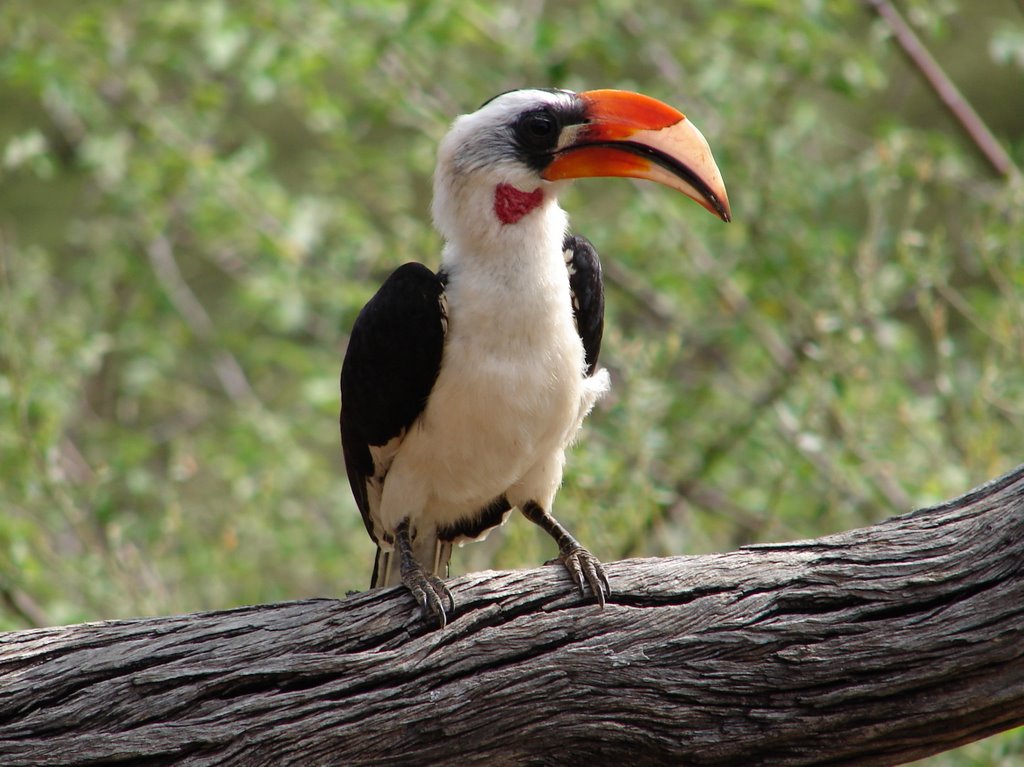
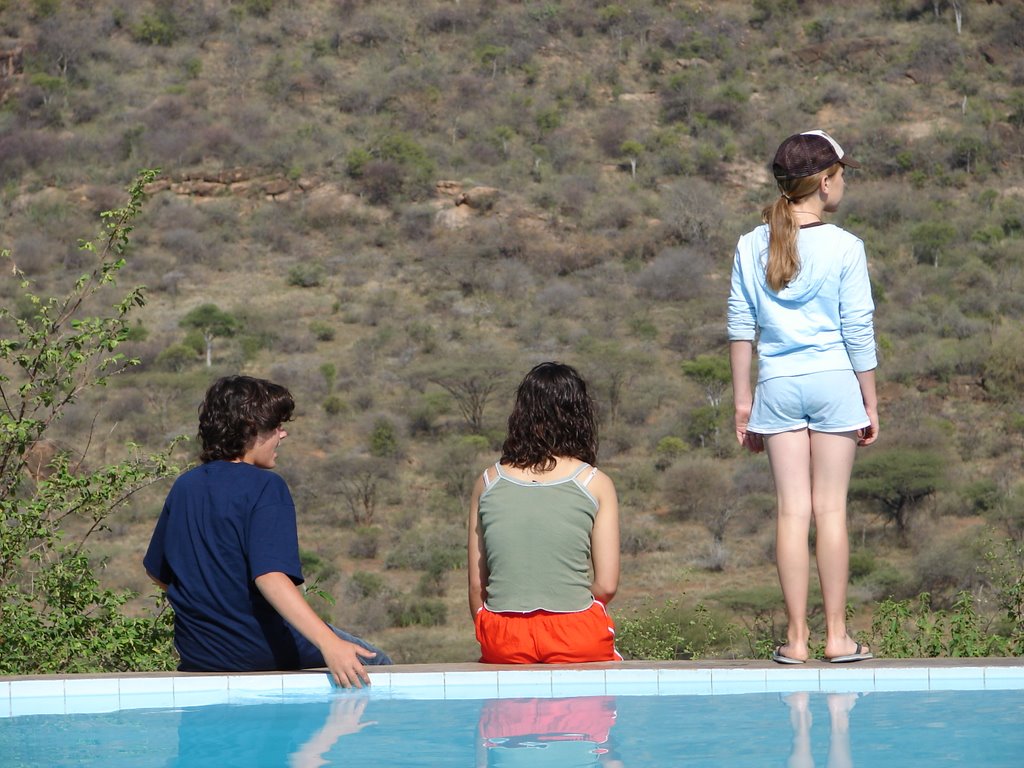
It's a wonderful part of the country, with plentiful opportunities for more unusual kinds of safari, such as walking and camel safaris, and fantastic wildlife viewing opportunities (that's a Von der Decken's hornbill – a pair of them came and perched outside our room for about 5 minutes – a lot of fun for a keen photographer). Elephants tramped by every day, along the valley in front of where the kids are standing. The six enormous rooms, completely open to the view and the elements, are ranged either side of the pool.

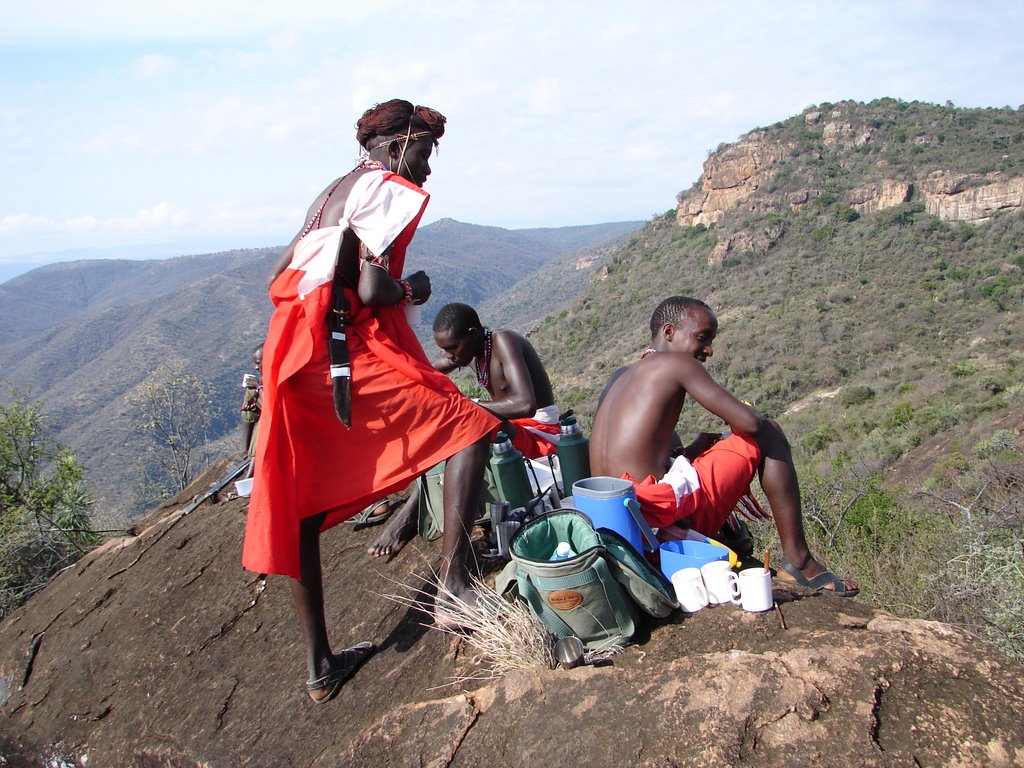
These photos were taken in and around Il Ngwesi, one of Laikipia's foremost eco-lodges. A large proportion of the places to stay in Laikipia make efforts to limit their environmental footprint and Il Ngwesi – owned and run by the Il Ngwesi Maasai (top right picture) on behalf of their 6000-strong community – has helped lead the way in what tourists want and what works in local conditions. They're okay with the infinity pool (recenty de-infinitized by the kids in this shot) so long as their own herds have enough to drink. And the $250 per person per night rate helps too.

Sunday, November 26, 2006

Latest fees in the Maasai Mara area

0 comments
Maasai Mara fees also went up, but in a somewhat confusing and complicated way. The reserve itself, south of the Talek and east of the Mara River, and the group ranch area to the north of the Talek, are still charging $30 per day per person. There is, however, no free movement betwen the two, as there has been for years. Now, you have to pay again! The Mara Conservancy, the triangle formed by the Mara river, the escarpment and the Tanzanian border, is charging $40. This information comes from Kicheche camp. They told me "Not sure how this will pan out in 2007 as there is a lot of politics ongoing. We have to play it by ear." Politics in the Mara? That's putting it mildly from what I've heard. But that'll have to wait for another post.

Saturday, November 25, 2006

Bad news for your budget

1 comments

National Park fees increased across the board last summer – frustratingly just after the latest edition of the Rough Guide went to the printers. But heh, that's what blogs are for, right?

The main parks raised their daily entrance fees from, in most cases, $30 to $40 for non-residents of Kenya, with other parks somewhat cheaper. Click on the table to view it more legibly (click "refresh" if you get gibberish).

And visit the Kenya Wildlife Services' very useful website for further details of camping fees and accommodation.

Sunday, November 19, 2006

Good news on Mount Elgon

0 comments

Lillian Nsubuga, writing in The East African (Nairobi) says Uganda and Kenya have recently allowed visitors to Mt Elgon National Park to cross the mountain's common border. Tourists visiting the park will now be allowed to climb Mt Elgon from either side. She goes on to say that more than 100 visitors have already made the crossing which previously involved making arrangements in advance with the park authorities. She reports the chief warden of the park as saying tourism authorities in the two countries had improved security to stop illegal immigrants from abusing the cross-border tourism facility.

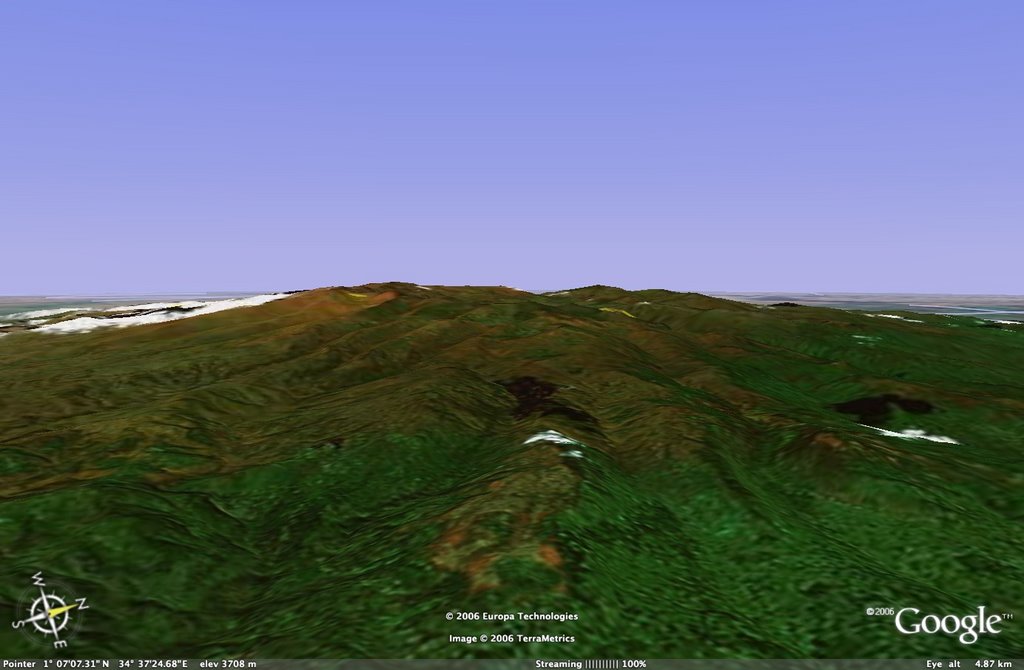
The image from Google Earth shows Mount Elgon - a real giant in overall area, though not as high as Mount Kenya at 4231m, and below the snowline – viewed from a little west of Kitale on the Kenyan side. The white stuff? Clouds.

Sunday, November 12, 2006

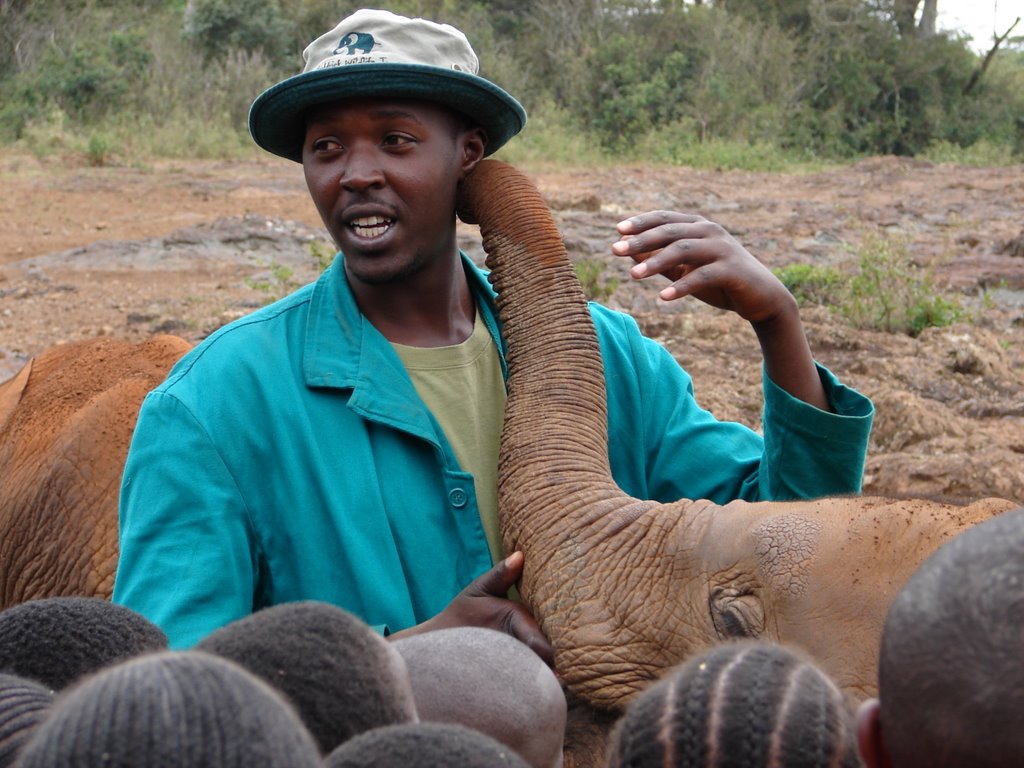
From the Rough Guide coverage of the David Sheldrick Wildlife Trust elephant and rhino orphanage

1 comments

After many years of trial and error, David Sheldrick's widow, Dame Daphne Sheldrick, and her staff, have become the world’s experts on hand-rearing baby elephants, sometimes from birth, using a specially devised milk formula for the youngest infants and assigning keepers to individual 24-hour physical guardian-ship of their charges, a responsibility that includes sleeping with them in their stables. Without the love of a surrogate family and plenty of playtime and stimulation, orphaned baby elephants fail to thrive: they can succumb to fatal infections when teething, and, if they physically survive, can grow up unhappy and badly prepared for reintroduction to the wild. At the time of writing, there were nine baby elephants at the orphanage and two partly rehabilitated young rhinos who make occasional and brief visits.